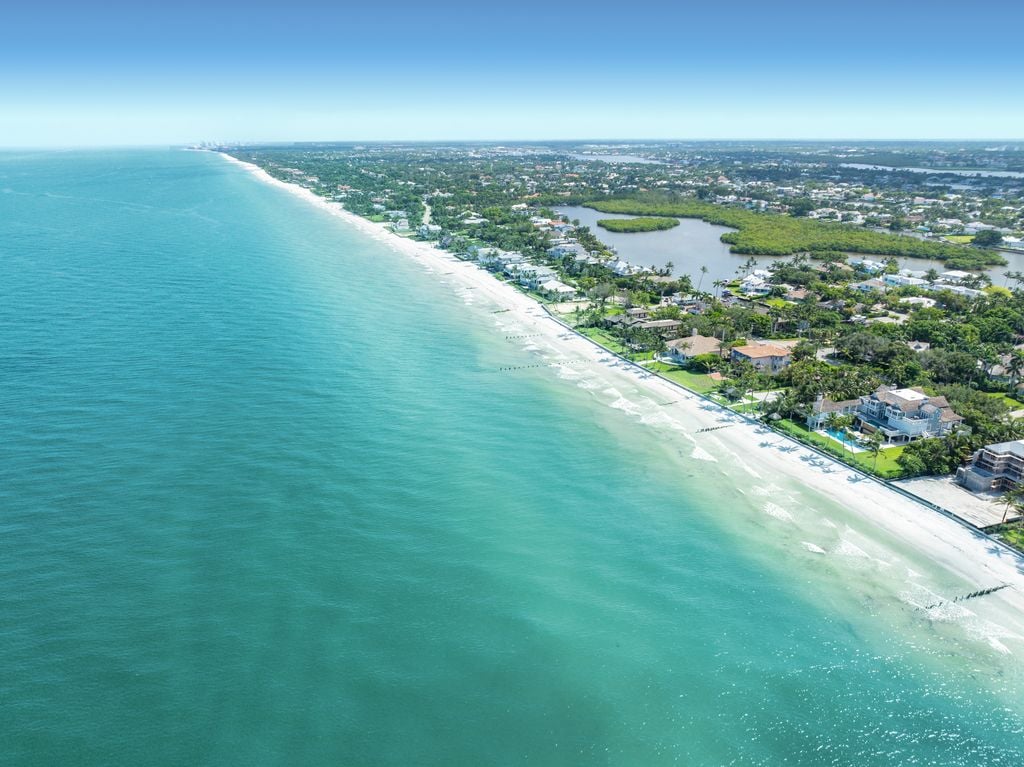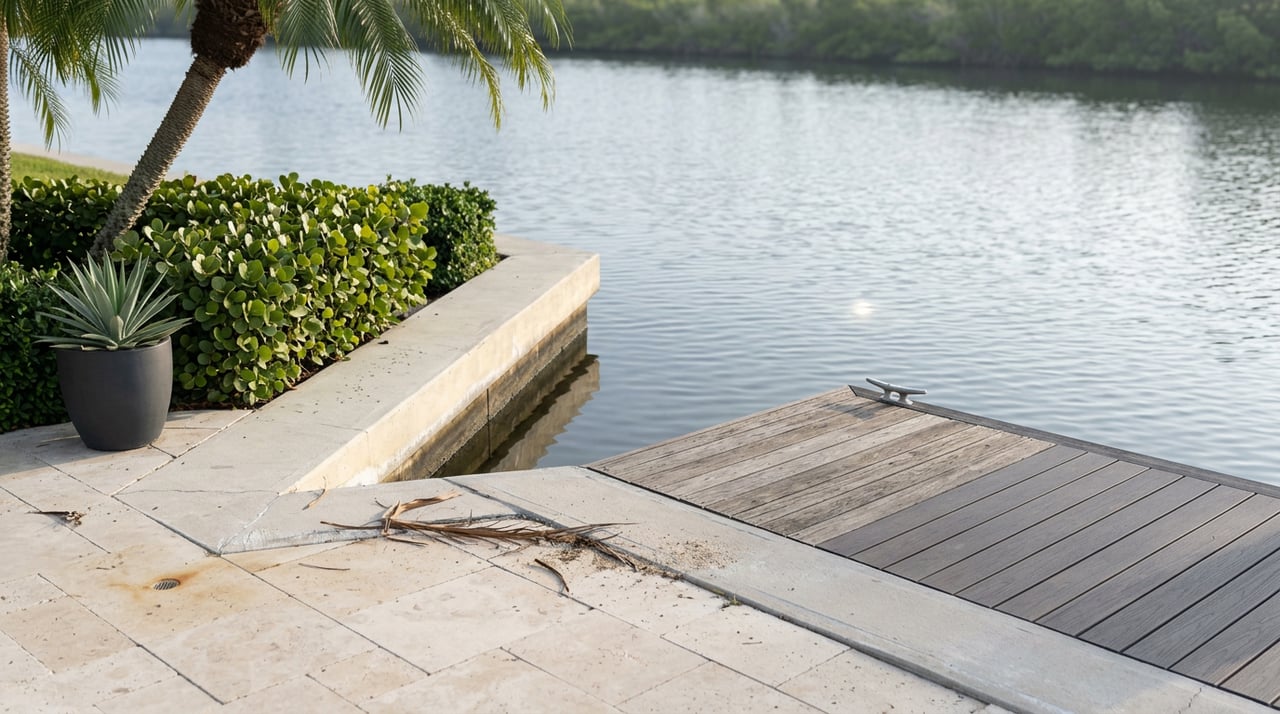
A boat idling at a private dock on Kingfish Road in Royal Harbor and a boat idling at a private dock in Port Royal face the same run to open water. Both cross Naples Bay, both pass under exactly zero bridges, and both reach the Gulf through Gordon Pass in about the same number of minutes. The tide doesn't care which side of the bay you left from. Neither does the depth gauge.
The listing price does.
For the three months ending June 2026, Port Royal homes sold at a median of $17.0 million. Across the bay in Royal Harbor, the median asking price for the 35 homes on the market in early June was $3.95 million. Same access. Same pass. A gap of more than four times.
That gap is the whole story here, and it's worth taking apart carefully, because the answer isn't "location" in the vague sense every listing description reaches for. It's something more specific and more useful to a buyer standing in front of a Royal Harbor listing trying to figure out what they're actually being asked to pay for.
The Access Isn't the Variable
Start with what Royal Harbor, Aqualane Shores, and Port Royal genuinely share. All three sit on canals or open bay frontage that connect to Naples Bay and, from there, to the Gulf of Mexico through Gordon Pass with no fixed bridges along the route. That's a real engineering fact, not marketing language, and it's the reason all three neighborhoods show up on any serious Naples boater's short list. A sailboat or a large sportfisher that would be stuck behind a low bridge elsewhere in Naples can run from any of these three addresses without waiting on a tide window or a bridge tender.
If bridge-free Gulf access were the whole product, these three markets would price close to each other. They don't, and the three months ending June 2026 make that plain:
Neighborhood | Price benchmark | Window | Average days on market |
|---|---|---|---|
Royal Harbor | $3.95M median list price | Early June 2026 | 146 |
Aqualane Shores | $8.6M median sale price | 3 months ending June 2026 | 156 |
Port Royal | $17.0M median sale price | 3 months ending June 2026 | 170 |
Royal Harbor isn't slower to sell or less desirable to boaters. Its own listings carried an average asking price of $1,661 per square foot as of that early June snapshot, which is real money for real waterfront. It's simply priced against a different set of variables than the water itself.
What the Premium Is Actually Buying
Three things separate Port Royal and Aqualane Shores pricing from Royal Harbor pricing, and none of them show up on a canal depth chart.
The first is distance to the door of downtown. Aqualane Shores sits between Port Royal and Old Naples, close enough that owners routinely walk to Third Street South for dinner. Royal Harbor sits on the opposite shore of Naples Bay, close to the same restaurants and shops in driving minutes rather than walking ones. That's a small difference in miles and a real one in how a Tuesday evening actually unfolds.
The second is where each neighborhood sits on its own rebuilding timeline. Aqualane Shores and Port Royal have been cycling through teardown and new construction for decades, and a larger share of their current housing stock reflects that. Royal Harbor's version of the same cycle started later, picking up momentum in the late 1990s and continuing today, which means a meaningful share of its lots still carry homes built in the 1950s through 1970s. Averaging sale prices across a neighborhood that's only partway through a rebuilding cycle pulls the number down compared to a neighborhood further along the same curve, even when the underlying land and access are comparable.
The third is the intangible weight of the address itself. Port Royal in particular carries a reputation that predates any individual sale, and buyers pay for that reputation independent of what the water actually does for them day to day. Royal Harbor has never asked for that premium. Multiple longtime local brokerages describe it plainly as the boating community buyers choose specifically because it delivers comparable water without the address tax, which is a fair description of what the numbers above actually show.
The Same Split Happens Inside Royal Harbor
Here's the part that matters most if you're actually shopping there. The three forces that separate Royal Harbor from its pricier neighbors also operate inside Royal Harbor, on the same streets, sometimes on the same block.
Royal Harbor's 2024 closed sales tell that story in aggregate: 16 single-family homes sold at an average of $5.9 million, or roughly $1,484 per square foot, averaging just under 4,000 square feet. That average blends two very different products. At one end, a fully rebuilt new-construction home on Kingfish Road listed at right around $1,042 per square foot, benefiting from modern construction and finish levels a 1960s original can't match. At the other end, the same street's biggest 2024 sale went for just under $12 million for an 8,450 square foot estate built in 2002 on a 0.40-acre lot, a price that reflects size and a slightly newer build rather than a raw land premium.
Land value alone tells a third version of the same story. One Royal Harbor waterfront homesite listed earlier this year priced new construction starting at $6.5 million, before a single wall goes up, purely on the strength of frontage and no-bridge access. A separate build-ready lot elsewhere in the neighborhood carried 158 feet of water frontage, bridge-less access, and permitted plans for a nearly 6,000 square foot custom home, evidence that raw Royal Harbor dirt with the right frontage trades well into seven figures on its own, before construction even starts.
Put those data points next to each other and the pattern is unmistakable. The same no-bridge access to Gordon Pass sits underneath a $6.5 million raw lot, a roughly $1,042 per square foot new build, and a nearly $12 million 2002-era estate, all within Royal Harbor's boundaries. The water isn't pricing that spread. The build year and the finish level are.
Current activity backs this up. Recent Royal Harbor new construction has come from names like Stofft Cooney Architects and Equinox Construction, and one home under construction along the protected mangroves of Haldeman Creek is being built to roughly 6,000 square feet on 228 feet of waterfront. That's not a neighborhood coasting on its original 1950s bones. It's a neighborhood actively mid-transformation, which is exactly why a single median number can mislead a buyer who doesn't know which side of that transformation a specific listing sits on.
What to Actually Check Before the Number Means Anything
A Royal Harbor listing's price per square foot tells you almost nothing until you know where the property sits on this curve. Before comparing one listing to another, or to a comparable address in Aqualane Shores or Port Royal, it's worth confirming a short list of specifics:
- Build year and last major renovation. A 1960s original and a 2025 rebuild on the same street can carry wildly different per-square-foot economics even with identical frontage.
- Street and sub-area. Kingfish, Snook, Tarpon, and Marlin sit on the neighborhood's open-bay and wide-canal frontage. The Oyster Bay enclave, by contrast, includes a cluster of condominiums and villas, a different product entirely at a different price point.
- Canal width and depth. Not every Royal Harbor canal accommodates the same vessel. Some support deep-draft sailboats; others limit owners to shallow-draft power boats. This is worth confirming directly rather than assuming from the neighborhood's reputation.
- Dock and lift specifications. Listed lift capacities in Royal Harbor have ranged from roughly 10,000 to 30,000 pounds in recent listings, a meaningful difference for anyone planning to keep a specific boat.
- HOA structure. Royal Harbor's homeowners association is voluntary, covering common areas and a clubhouse rather than mandatory dues tied to every deed. That's a different cost structure than a mandatory association, and worth factoring into any side by side comparison with a neighboring community.
A Few Questions Worth Asking Directly
Is Royal Harbor gated? No. It's an open, non-gated neighborhood, which is part of why its pricing structure differs from communities that build gate maintenance and controlled access into their carrying costs.
Does every home in Royal Harbor reach the Gulf without a bridge? Every canal in the neighborhood connects to Naples Bay and, from there, to Gordon Pass without a fixed bridge. What varies is depth and width, which determines what size and draft of vessel a specific dock can actually accommodate.
The Number on the Portal Isn't the Whole Answer
A median price is a starting point, not a verdict. In a neighborhood mid-transformation like Royal Harbor, the honest answer to "what does this cost" depends on exactly which decade of construction you're standing in front of, and exactly how far that dock sits from the last bridge you'd otherwise have to wait on.
If you're weighing a Royal Harbor address against Port Royal or Aqualane Shores, or trying to read what a specific Royal Harbor listing's price per square foot is actually telling you, that's precisely the kind of building-by-building, street-by-street context worth getting right before you make an offer. The Beachfront Team tracks these micro-markets down to the individual dock and lot line. Experience the Beachfront Difference. Schedule a confidential consultation before you price your next move on a number that only tells half the story.